🎸 Capo Chart Calculator
Find your capo position, transpose chords & match any key instantly
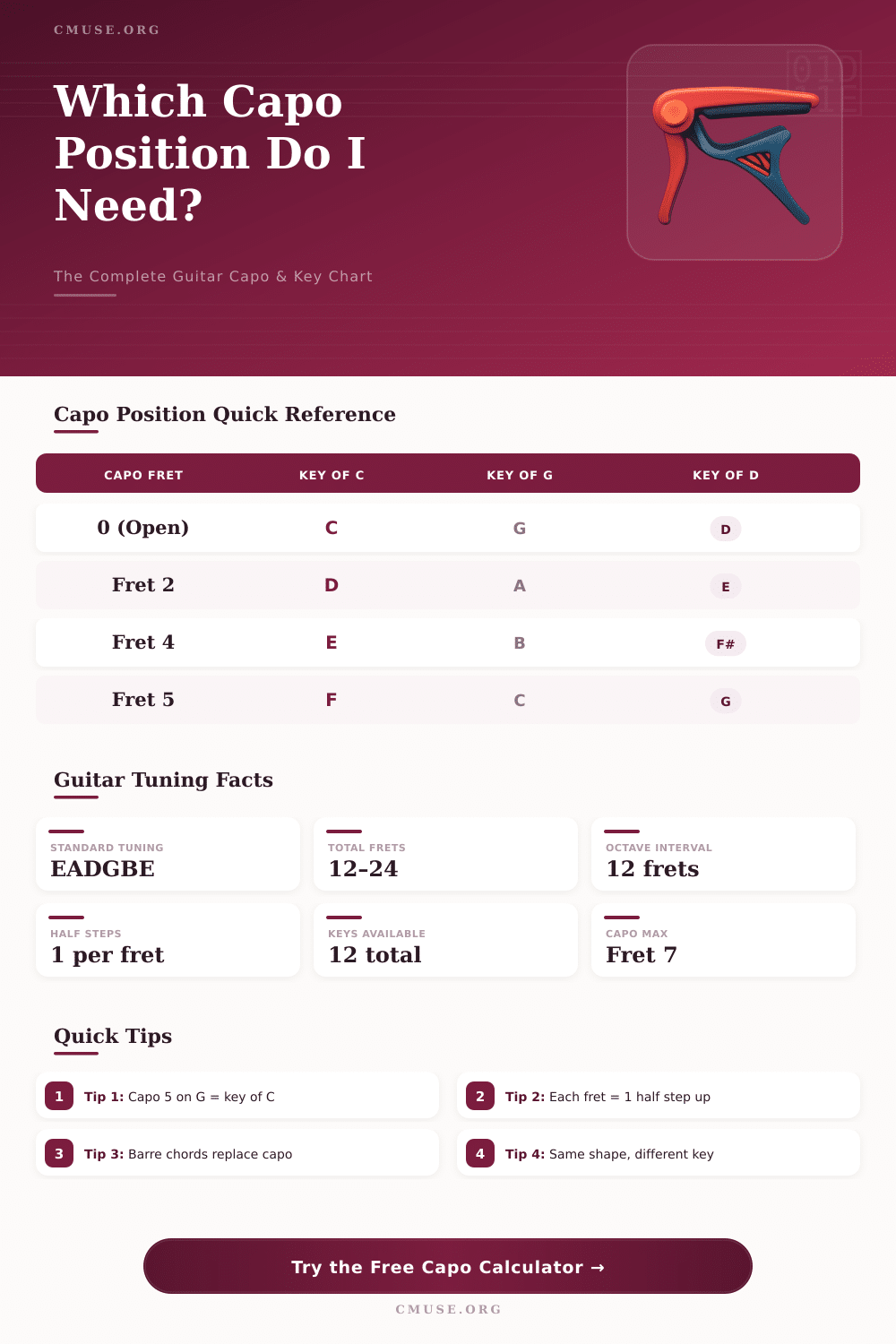
| Capo Fret | Play C → | Play G → | Play D → | Play A → | Play E → |
|---|---|---|---|---|---|
| Open (0) | C | G | D | A | E |
| Fret 1 | Db | Ab | Eb | Bb | F |
| Fret 2 | D | A | E | B | Gb |
| Fret 3 | Eb | Bb | F | C | G |
| Fret 4 | E | B | Gb | Db | Ab |
| Fret 5 | F | C | G | D | A |
| Fret 6 | Gb | Db | Ab | Eb | Bb |
| Fret 7 | G | D | A | E | B |
| Fret 8 | Ab | Eb | Bb | F | C |
| Fret 9 | A | E | B | Gb | Db |
| Fret 10 | Bb | F | C | G | D |
| Fret 11 | B | Gb | Db | Ab | Eb |
| Fret 12 | C | G | D | A | E |
| Shape Played | Capo 1 | Capo 2 | Capo 3 | Capo 4 | Capo 5 |
|---|---|---|---|---|---|
| Am | Bbm | Bm | Cm | C#m | Dm |
| Em | Fm | F#m | Gm | G#m | Am |
| C | Db | D | Eb | E | F |
| G | Ab | A | Bb | B | C |
| D | Eb | E | F | Gb | G |
| Dm | Ebm | Em | Fm | F#m | Gm |
| F | Gb | G | Ab | A | Bb |
| A | Bb | B | C | Db | D |
| Instrument | Open Strings | Capo Effect | Common Capo Range |
|---|---|---|---|
| Acoustic / Electric Guitar | E A D G B E | Raises all strings | Frets 1–7 |
| Drop D Guitar | D A D G B E | Raises all strings | Frets 1–5 |
| Ukulele | G C E A | Raises all strings | Frets 1–5 |
| Banjo (5-string) | g D G B D | 5th string needs spike | Frets 1–4 |
| Mandolin | G D A E | Raises all strings | Frets 1–5 |
| Bass Guitar | E A D G | Rarely used with capo | Frets 1–3 |
| Nashville # | Key of G | Key of C (Capo 5) | Key of D (Capo 7) |
|---|---|---|---|
| 1 (I) | G | C | D |
| 2 (II) | Am | Dm | Em |
| 3 (III) | Bm | Em | F#m |
| 4 (IV) | C | F | G |
| 5 (V) | D | G | A |
| 6 (VI) | Em | Am | Bm |
| 7 (VII) | F#m | Bm | C#m |
Capo is tiny, but strong aid that belongs in the kit of every guitarist. It opens the fretboard up, helps to learn songs more simply, without barring strings and complicated moves, and allows to change songs to other keys very quickly. Capo is useful for giving the guitar a sound of simple overall.
The main benefit of Capo is that it lets a guitarist play in difficult keys by using basic open strings. Even so, knowing where to lay the Capo can become confusing. Here comes the chart for guitar Capo.
Simple Capo Chart for Guitar
It helps to decide where to place the Capo to reach the wanted tone.
Basic keys that acoustic guitarists most use are five: C, D, E and G. By using Capo one can use the forms of those chords to play in any otehr key. For instance, Capo on the first fret opens access to F, Bb, Eb, Ab and Db chords. A practical way is to prepare a chart about open chords for the first three or four positions of Capo and check it always when a new song appears.
To alter the key of a song by using Capo, first figure out in what key the music started. Looking at the top of the pages of the notes is useful hear. If there are no sharps or flats, the piece is in C key.
After you find the original key, choose the intended one and use the chart to find the right position of the Capo.
Here are some usual changes. C-form with Capo on second fret results in D. D-form with Capo on third fret gives F. G-form with Capo on second fret results in A. E-form with Capo on third fret gives G. A-form with Capo on third fret gives C. That counts for minors also. For instance, Am-form with Capo on fifth fret gives Dm.
After the Capo is laid, it must be straight and touch flat on the fret. A good way to manage the method is to slide the Capo upward and play the same chord forms, while one listens as the sounds change. Writing on paper a basic chart about the moves of chords on various frets also really helps.
One spot that commonly confuses is the labeling of chords. When Capo sits on the third fret and one plays D-form, the real sound is F. A pianist that reads a diagram marked “G”, but that actually means G-form with Capo on second fret, would play wrong notes. The ebook about Capo Chart carries more than 400 diagrams of chords for frets of 1 to 9, together with partial Capo chords and other types.
Partial Capo touches only some strings, leaving the other open, which differs fromnormal Capo that presses all strings.