🎵 Royalty Streaming & Unit Calculator
Calculate streams needed for certifications, TEA/SEA units, and royalty distribution across platforms
| Certification | Sales Units | Track Streams (TEA) | Album Streams (SEA) |
|---|---|---|---|
| Gold | 500,000 | 75,000,000 | 62,500,000 |
| Platinum | 1,000,000 | 150,000,000 | 125,000,000 |
| 2x Platinum | 2,000,000 | 300,000,000 | 250,000,000 |
| 5x Platinum | 5,000,000 | 750,000,000 | 625,000,000 |
| Diamond | 10,000,000 | 1,500,000,000 | 1,250,000,000 |
| Metric | Streams Required | Equals | RIAA Standard |
|---|---|---|---|
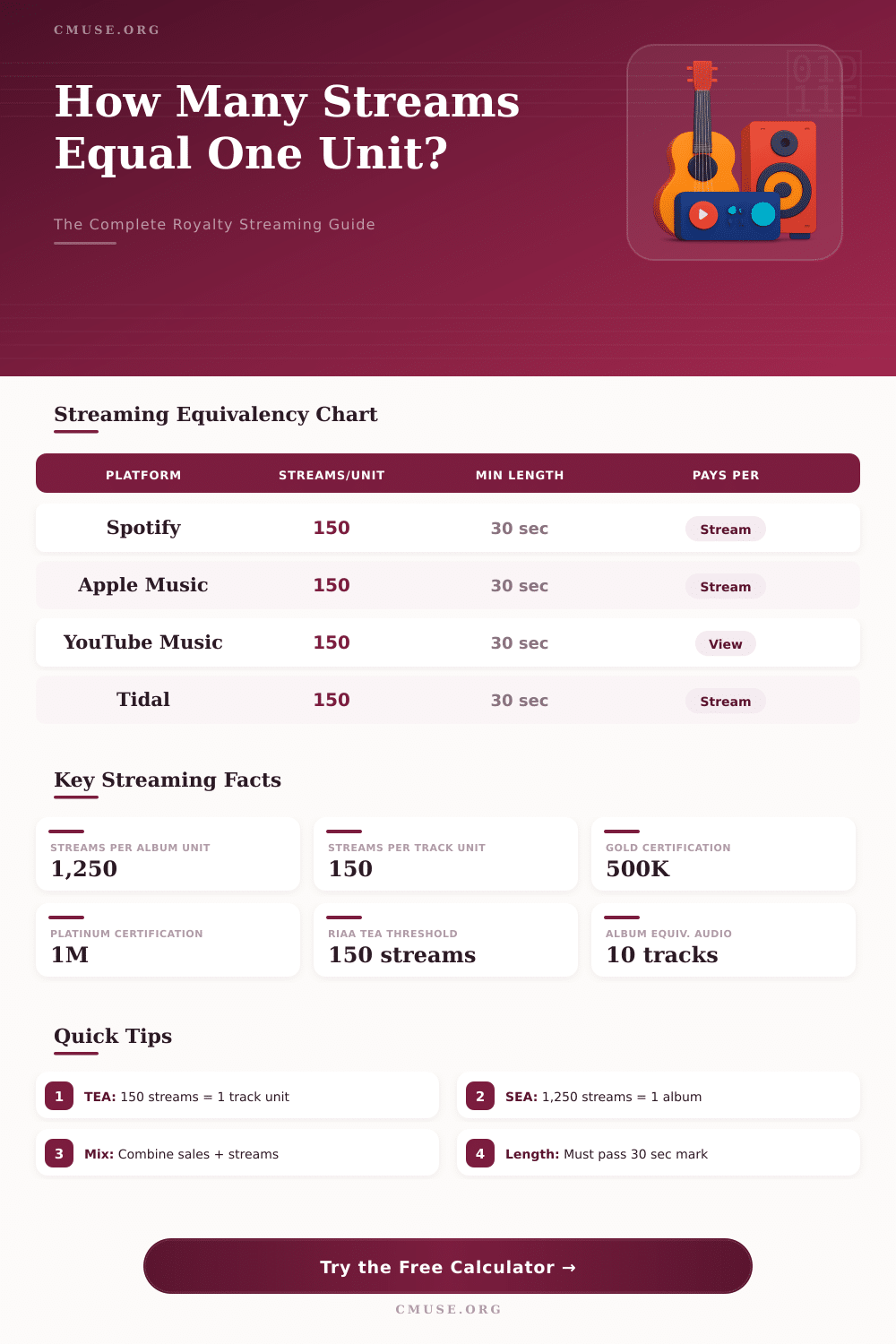
| 1 Track Equiv. Album (TEA) | 150 streams | 1 track unit | Yes |
| 1 Stream Equiv. Album (SEA) | 1,250 streams | 1 album unit | Yes |
| 10 TEA | 1,500 streams | 10 track units | Yes |
| 1,000 TEA | 150,000 streams | 1,000 track units | Yes |
| Gold (Track) | 75,000,000 | 500,000 TEA | Yes |
| Platinum (Track) | 150,000,000 | 1,000,000 TEA | Yes |
| Platform | Min Stream Length | Streams/Hr (3 min tracks) | TEA Units/Hr |
|---|---|---|---|
| Spotify | 30 seconds | 20 | 0.13 |
| Apple Music | 30 seconds | 20 | 0.13 |
| Tidal | 30 seconds | 20 | 0.13 |
| YouTube Music | 30 seconds | 20 | 0.13 |
| Amazon Music | 30 seconds | 20 | 0.13 |
| Pandora | 60 seconds | 17 | 0.11 |
| Project Type | Total Streams | TEA Units | SEA Album Units |
|---|---|---|---|
| Indie Single (Small) | 50,000 | 333 | 40 |
| Emerging Artist Single | 500,000 | 3,333 | 400 |
| Mid-Level Album | 5,000,000 | 33,333 | 4,000 |
| Major Label Single | 50,000,000 | 333,333 | 40,000 |
| Chart-Topping Hit | 500,000,000 | 3,333,333 | 400,000 |
When a song is heard on Spotify, YouTube or Apple Music, some receive money, at least according to theory. Those incomes generate royalties, that flow to artists, record companies, authors of songs and publishers. The idea itself is quite simple however the real way the money spreads?
Here is where the problems start.
Who Gets the Money When You Stream a Song
Here is how it works at the level of platforms. Services for streaming pour all their income into one big pool, later they split it according to who gets the most hearings. One ranks the artists according to public size, sales and some other things before counting the portions.
More subscriptions and ad incomes force a bigger amount to share. On paper it seems very simple.
The method of Spotify deserves attention. One calls it a pari-mutuel system, so based on big shared splitting as in gambling. Every dollar, that one gathers, enters the mutual pocket.
The platform right away took around 30 percent for itself. What stays, divides between the artists according to the portion of their total hearings. For real income you require millions of relpays.
Now, where does the most of that money end up? The owner of master rights walks away with the biggest part; we talk about 85 percent from those 70 percent, that the platform gives out. Record companies usually have those master rights, and they decide how to cut the payments to their artists.
In audio streams, the owners of rights receive typical around 80 percent of the value of the stream. Video streams give a bit less, give or take.
Authors of songs and publishers receive their part also, although it stays fairly little. Here the mechanical royalty, the payment for the song itself, that is part of the recording. It usually sits around 10 percent of the hole royalty streaming,unit division.
Publishers use administrators of mechanical licenses (for instance Harry Fox Agency or the Mechanical Licensing Collective in United States) to gather that amount. The mechanical payment of Spotify for a stream sits somewhere around 0.0006, what truly does not impress.
Here is something important to note: songs shorter than 30 seconds do not really generate royalties, that deserves mention. It depends on land and kind of right, but it stays almost nothing. Streaming always finds itself in the bottom part of the range of royalty incomes.
Even so, if one covers many platforms with a broad net and uses management for publishers, one grabs those publishing and mechanical royalties, what does make a real difference.
Many free tools exist to guess how far you could win from platforms like Spotify, Apple Music, YouTube or Amazon Music. Enter your number of hearings and your questions about royalties, and you will be able to estimate what falls in your pocket after companies and publishers take their fee. The truth?
Around 80 percent of artists on Spotify earn 200 dollars or less yearly from streams. Most musicians mix it today, they combinedownloads, streaming and other incomes to only reach their music salary.