🔊 Amplifier Speaker Wattage Calculator
Match your amplifier power to your speaker RMS rating for safe, optimal audio performance
ℹ️ Ratio = Amp RMS ÷ Speaker RMS. Values above 1.0 risk speaker damage if pushed hard.
| Sensitivity (dB/1W/1m) | 1 Watt SPL | 10W SPL | 100W SPL | 1000W SPL |
|---|---|---|---|---|
| 85 dB | 85 dB | 95 dB | 105 dB | 115 dB |
| 87 dB | 87 dB | 97 dB | 107 dB | 117 dB |
| 89 dB | 89 dB | 99 dB | 109 dB | 119 dB |
| 90 dB | 90 dB | 100 dB | 110 dB | 120 dB |
| 92 dB | 92 dB | 102 dB | 112 dB | 122 dB |
| 95 dB | 95 dB | 105 dB | 115 dB | 125 dB |
| 98 dB | 98 dB | 108 dB | 118 dB | 128 dB |
| 100 dB | 100 dB | 110 dB | 120 dB | 130 dB |
SPL increases by 3 dB each time power doubles. Distance halving adds ~6 dB.
| Config | Individual Impedance | Total Load | Power per Speaker |
|---|---|---|---|
| 1x Speaker | 8 Ω | 8 Ω | 100% of amp output |
| 2x Parallel | 8 Ω each | 4 Ω | 50% each (amp delivers more) |
| 4x Parallel | 8 Ω each | 2 Ω | 25% each (amp delivers max) |
| 2x Series | 8 Ω each | 16 Ω | 50% each (amp delivers less) |
| 1x Speaker | 4 Ω | 4 Ω | ~2x more than 8Ω |
| 2x Parallel | 4 Ω each | 2 Ω | 50% each |
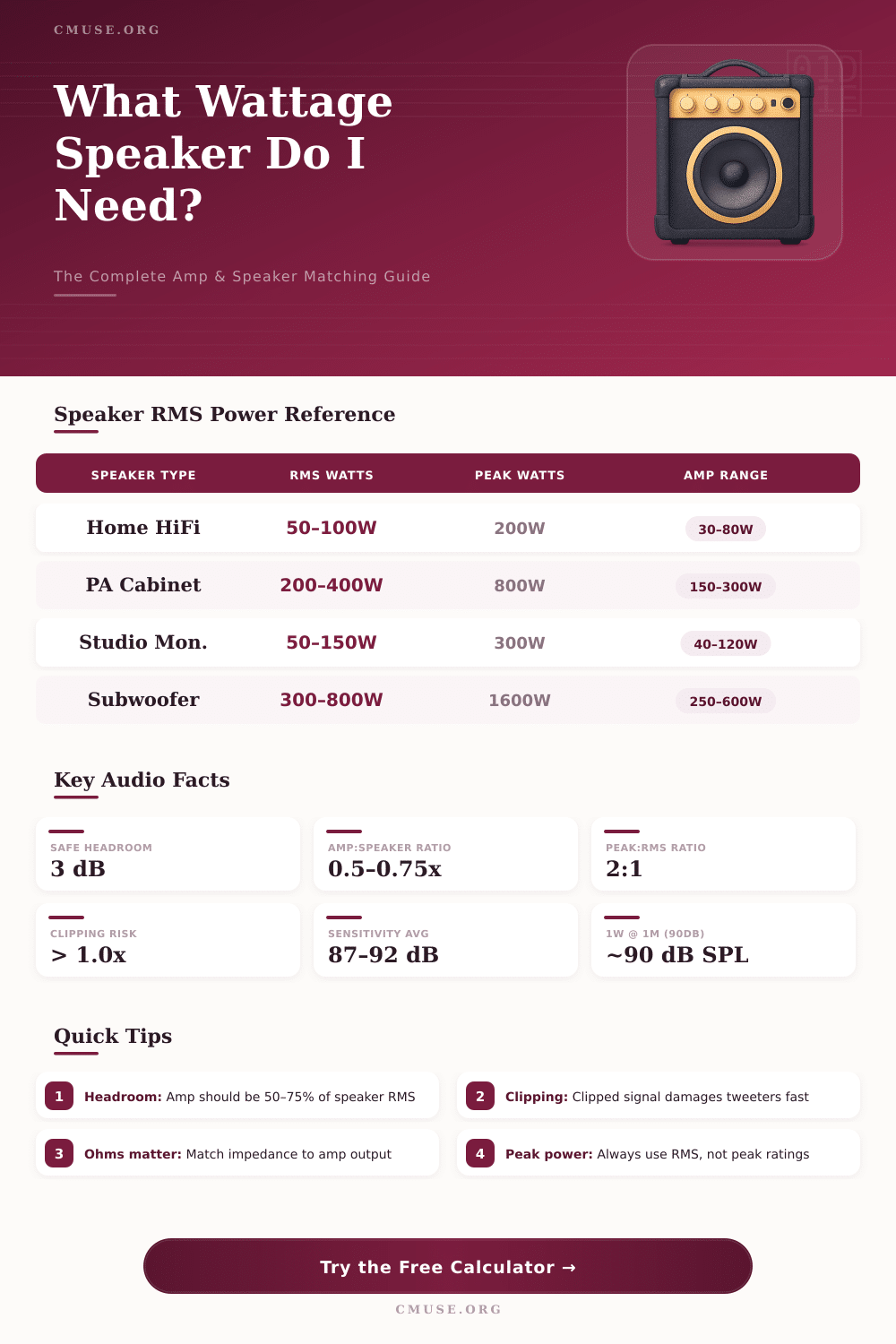
| Application | Typical RMS (W) | Peak Power (W) | Ideal Amp RMS (W) | Sensitivity |
|---|---|---|---|---|
| Bookshelf HiFi | 50–100W | 200W | 30–75W | 85–88 dB |
| Floorstanding HiFi | 100–200W | 400W | 60–150W | 87–92 dB |
| Studio Monitor (nearfield) | 50–150W | 300W | 40–120W | 88–92 dB |
| PA/Live Cabinet | 200–800W | 1600W | 150–600W | 95–102 dB |
| Guitar 1x12 Cabinet | 65–100W | 200W | 30–80W | 95–100 dB |
| Guitar 4x12 Cabinet | 120–280W | 560W | 80–200W | 98–102 dB |
| Bass Cabinet 4x10 | 400–800W | 1600W | 250–600W | 98–103 dB |
| Subwoofer | 300–1000W | 2000W | 250–800W | 85–92 dB |
| Home Theater Center | 80–150W | 300W | 50–100W | 88–92 dB |
| Car Audio Mid-Bass | 100–300W | 600W | 100–250W | 89–94 dB |
The power of Speaker points how much electrical energy it fits to last and convert into sound. The bigger the number the more power the Speaker receives without risk of damage. Although folks usually link watts with only the loudness of sound, truly everything goes more deeply, it also affects the general mode, the lifespan of the device, the cleaning of the sound and the overall stability.
Watt simply measures the power. It matches to volts multiplied by amps. As for speakers, this indication shows how much energy the Amplifier successfully carries and how the Speaker lasts before distortions appear or something breaks.
What Speaker Watts Mean and How to Match an Amplifier
Here the key: the Wattage rating of the Amplifier reveals its output, while that of the Speaker points its receiving skill. Both values describe different parts of the same process.
The Wattage self do not guarantee goodness of sound for everything. It only measures how much energy flows into the speakers in particular sensitivity. Hence it is foolish to insist only on this number.
A well built 25-watt Amplifier commonly sounds better than a bad done 50-watt model (with clearer sound), better control and everything that follows. Truly importing is teh quality of the Amplifier, how well it delivers the energy and whether it well matches with your own speakers.
There is no uniform mode as makers mark the Wattage of speakers, what makes it a bit random. During decades, companies simply laid various numbers on them without any basis, and even in practical hearing most speakers only use between 2 and 5 watts of steady energy. Most speakers operate in typical range.
Probably 10 to 100 watts, give or take.
Sensitivity and impedance also matter a lot. The sensitivity point how loudly the Speaker sounds when it receives 1 watt from 1 metre. Higher sensitivity means that you need fewer energy to reach the wanted loudness.
Impedance is the electrical resistance that the Amplifier “sees”, and typical values are 4, 6 or 8 ohms. Here what is remarkable: a more sensitive Speaker will sound louder then a less sensitive one, if both receive the same watts. Bigger speakers usually have higher sensitivity, which helps.
The main advice is easy; the energy that your Amplifier generates should not pass the rating of the Speaker. Send 350 watts into a Speaker rated for 300 steady, and you can burn the voice coil and destroy the whole setup in only some minutes. On the other hand, having a bit of extra reserve in the Amplifier truly helps, because it allows you to enjoy purer sound at less high volumes, without distortion stepping in too early.
For daily musical hearing with average home speakers, between 50 and 150 actual watts work well. If you intend a more mighty system, 300 to 500 watts with matched speakers operate surprisingly well. In home context, what truly matters is the real sound quality of your speakers and Amplifier, not only the watts that the specs mention.
Bare Wattage self do not tell a lot about the real skill of the system, because the efficiency of the Speaker and the levels ofdistortion create big difference.