🎸 Bass Guitar String Tension Calculator
Calculate exact string tension for any gauge, scale length, and tuning — 4, 5, or 6 string basses
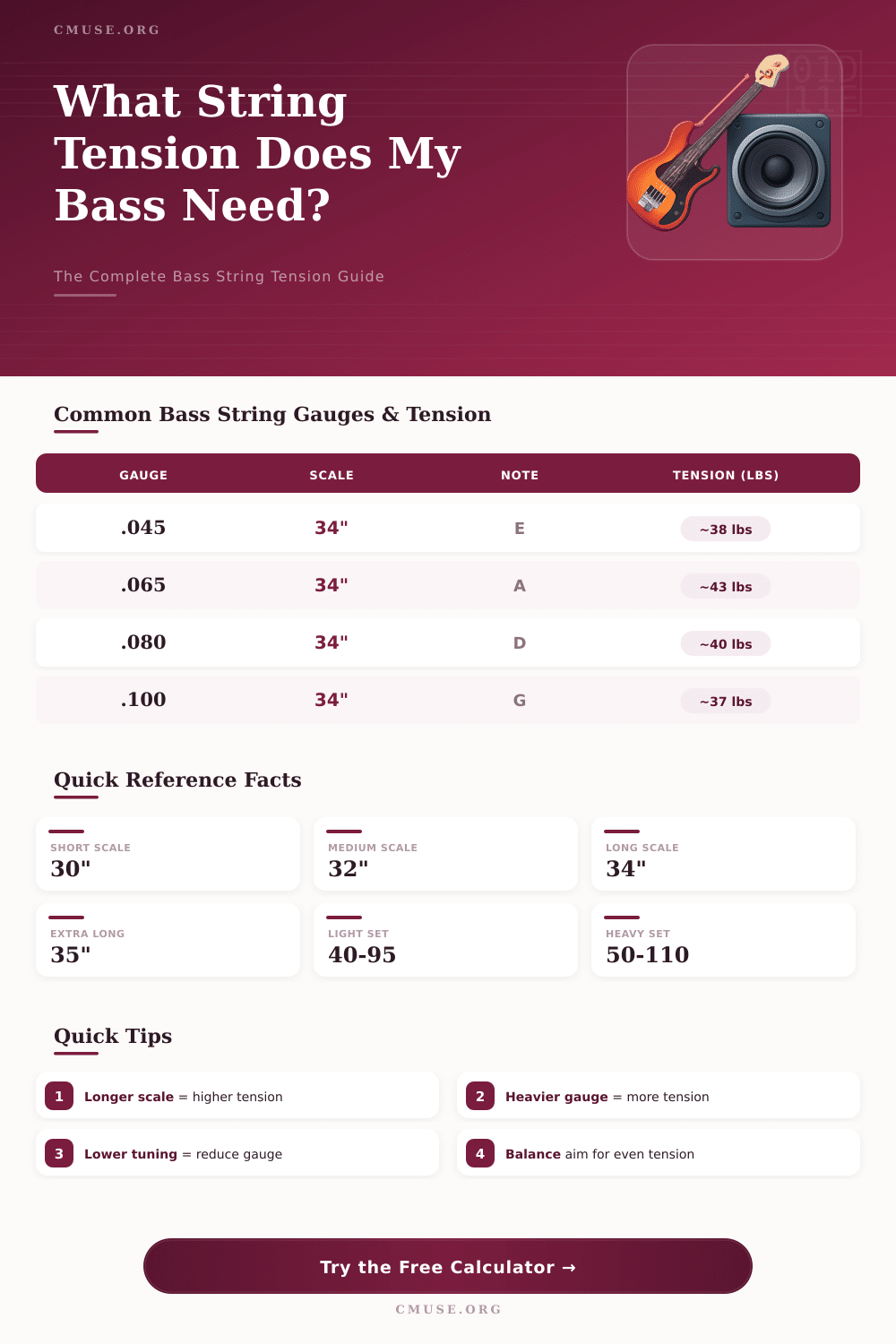
| Gauge | Note | 30" Short | 32" Medium | 34" Long | 35" X-Long |
|---|---|---|---|---|---|
| .040 | G | 24.7 lbs | 28.0 lbs | 31.7 lbs | 33.6 lbs |
| .045 | G | 29.4 lbs | 33.4 lbs | 37.7 lbs | 40.0 lbs |
| .055 | D | 28.8 lbs | 32.7 lbs | 36.9 lbs | 39.2 lbs |
| .065 | A | 29.7 lbs | 33.7 lbs | 38.0 lbs | 40.4 lbs |
| .075 | A | 35.2 lbs | 39.9 lbs | 45.1 lbs | 47.8 lbs |
| .080 | D | 33.0 lbs | 37.4 lbs | 42.3 lbs | 44.8 lbs |
| .095 | E | 33.8 lbs | 38.4 lbs | 43.3 lbs | 45.9 lbs |
| .100 | E | 37.3 lbs | 42.3 lbs | 47.8 lbs | 50.6 lbs |
| .105 | E | 41.1 lbs | 46.6 lbs | 52.6 lbs | 55.8 lbs |
| .125 | B | 38.9 lbs | 44.1 lbs | 49.8 lbs | 52.8 lbs |
| .130 | B | 42.0 lbs | 47.6 lbs | 53.8 lbs | 57.0 lbs |
| Config | String 1 | String 2 | String 3 | String 4 | String 5 | String 6 |
|---|---|---|---|---|---|---|
| 4-String Std | G (98 Hz) | D (73.4 Hz) | A (55 Hz) | E (41.2 Hz) | — | — |
| 4-String Drop D | G | D | A | D (36.7 Hz) | — | — |
| 5-String Std | G | D | A | E | B (30.9 Hz) | — |
| 5-String Hi-C | C (130 Hz) | G | D | A | E | — |
| 6-String Std | C | G | D | A | E | B |
| Drop B | G | D | A | E | B (30.9 Hz) | — |
| Note | Octave | Frequency (Hz) | MIDI Note # |
|---|---|---|---|
| B | 0 | 30.87 Hz | 23 |
| C | 1 | 32.70 Hz | 24 |
| D | 1 | 36.71 Hz | 26 |
| E | 1 | 41.20 Hz | 28 |
| A | 1 | 55.00 Hz | 33 |
| D | 2 | 73.42 Hz | 38 |
| G | 2 | 98.00 Hz | 43 |
| C | 2 | 130.81 Hz | 48 |
When you buy bass strings, the tension of them really can not be ignored. It depends on some things that involves: the thickness of the string, the length of the scale of your bass, the used setup and the materials from which it consists. Even so here the spot, the mark or model of your instrument?
That does not have real meaning.
How Bass String Tension Affects Sound and Feel
Thick strings pull with natural force bigger. If you choose slimmer, play becomes easier and less tiring but you lost a bit of sustain and sound. The scale length adds new twist, long scales require more tension to stay stable.
Weird cause is, that two different makers can create the same size string, but it feels entirely different, what does comparisons between marks really hard.
Most musicians find their ideal tension between 40 and 45 pounds for the whole set. Around 40 pounds, your fingers feel it comfortable and a bit loose. At 45 pounds, you notice clear increased resistance under the hands.
Some favour really precise feeling, keeping everything at around 40 spots for all four strings. A lot of folks go under 35 spots, but then everthing becomes chaotic, the sound gets bad and the thick strings can slide off the fretboard.
Strong strings give rigid feeling, and that rigidity directly affects the tone. Pass from high to normal tension can surprisingly alter your bass sound. Sometimes dropping it results in something even better then before.
On nine-string basses, the options quickly limit. Some sets feel a bit loose, yet deliver strong tonal base. The Ernie Ball Kobalt strings belong to the more rigid, and D’Addario Lo-Riders reach quite a lot strong tension also.
To have Bass Guitar String Tension equal between the strings, matters more than one thinks. Each of them has different size, thicker for the low notes, slimmer for the high, so the tension stays fairly same during the whole set. Loose B-string in standard setup?
That is typical problem, especially on Fender-models compared to more modern instrument with good geometry. Programs like the Stringjoy-calculator help you reach perfectly equal tension. D’Addario and GHS share their specs about tension, what really saves the life when you want info to choose.
One can not alter the tension of set without re-set, what clearly is not good idea. What you can do, is alter the nut-height to drop the action, what reduces the pressure on your fingers. Those changes stop tiredness, although the tension itself stays the same.
Here where it gets interesting: when string stretches, it naturally curves more in the centre, so it moves bigger way while you pick it. More tension removes that movement. Bass strings have bigger motion than guitar strings, despite their high tensions.
A 120-size set reaches around 216 pounds of total tension across thewhole neck, what logically does folks care about the bridge, neck or tuners that must handle it.