🎸 Guitar String Tension Calculator
Calculate exact string tension by gauge, scale length & tuning — for any guitar or bass
| String | Gauge | Note | Freq (Hz) | Tension (lbs) | Tension (kg) | Tension Bar | Feel |
|---|
| String | Standard (E) | Half Down (Eb) | Drop D | Open G | Frequency (Hz) |
|---|---|---|---|---|---|
| String 1 (High) | E4 | Eb4 | E4 | D4 | 329.63 Hz |
| String 2 | B3 | Bb3 | B3 | B3 | 246.94 Hz |
| String 3 | G3 | F#3 | G3 | G3 | 196.00 Hz |
| String 4 | D3 | C#3 | D3 | D3 | 146.83 Hz |
| String 5 | A2 | Ab2 | A2 | G2 | 110.00 Hz |
| String 6 (Low) | E2 | Eb2 | D2 | G2 | 82.41 Hz |
| Scale Length | Common Use | 0.010 E4 (lbs) | 0.046 E2 (lbs) | Tension Change |
|---|---|---|---|---|
| 24.0" (Short) | Gibson SG, PRS SE | 12.8 | 17.1 | Lowest |
| 24.75" (Gibson) | Les Paul, ES-335 | 13.6 | 18.2 | Low-Med |
| 25.0" | PRS, Some acoustics | 13.9 | 18.6 | Medium |
| 25.5" (Fender) | Strat, Tele | 14.4 | 19.3 | Medium-High |
| 26.5" (Baritone) | Baritone guitar | 17.5 | 23.4 | High |
| 34" (Bass) | Standard bass | — | — | Bass range |
| Set Name | Gauges | Total Tension (lbs) | Best For | Feel |
|---|---|---|---|---|
| Super Light | .008-.038 | ~90–100 lbs | Lead, Shred | Light |
| Extra Light | .009-.042 | ~96–110 lbs | Blues, Country | Light |
| Regular Light | .010-.046 | ~111–130 lbs | Versatile | Medium |
| Medium | .011-.049 | ~130–150 lbs | Blues, Jazz | Medium |
| Heavy | .012-.054 | ~155–175 lbs | Drop tunings | Heavy |
| Extra Heavy | .013-.056 | ~170–195 lbs | Baritone, B | Heavy |
| String | Note | Light (.040-.095) | Medium (.045-.105) | Heavy (.050-.110) |
|---|---|---|---|---|
| G String | G2 (98 Hz) | 37.2 lbs | 43.4 lbs | 49.1 lbs |
| D String | D2 (73.4 Hz) | 34.1 lbs | 39.6 lbs | 44.3 lbs |
| A String | A1 (55 Hz) | 32.9 lbs | 38.2 lbs | 42.7 lbs |
| E String | E1 (41.2 Hz) | 35.3 lbs | 40.1 lbs | 44.9 lbs |
| Total Set | — | ~139 lbs | ~161 lbs | ~181 lbs |
String Tension simply shows how the strings are pulled tight. One measures it in pounds or kilos. If you played on several different guitars with various sets of strings, you probably noticed the difference in tension between them.
String Tension affects the tone, the length of sound and the feel. Under the fingers it changes the feeling of the string. High tension gives a stiff and hard feeling.
How String Tension Affects Tone, Feel and Tuning
Low tension seems more loose and flexible. Strings with low tension can feel like elastic rubber bands, compared to those with high tension, that feels clear and solid.
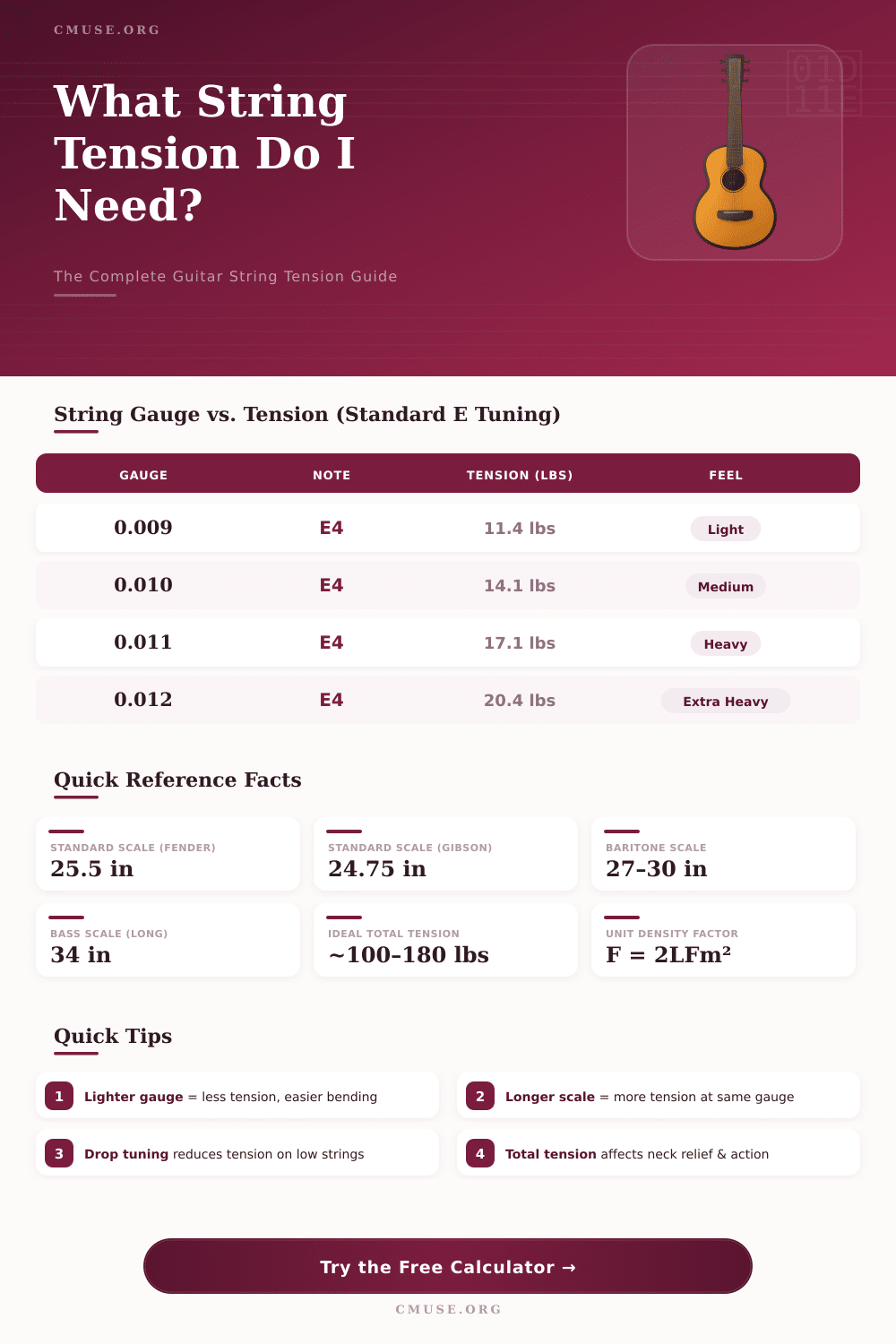
String Tension depends on three main things: the mass each inch of the string, the scale length of the Guitar and the pitch at which the string shakes. Scale length is simply the distance between the nut and the bridge. A shorter scale results in less String Tension.
The same level of tension can seem much more weak on a long scale, which is important for comparing scales of bass and Guitar.
If you raise the tension, the pitch climbs. Lowering it drops the pitch. When a tuner points that the string is too high, you should drop the tension.
If it shows too low a tone, turn the tuning peg to raise it. Without changing the strings, dropping tension causes play in lower pitch, and the sound will adjust. In lower settings the sound of the instrument becomes less like that of a normal Guitar.
For electric Guitar, a good starting point for size of strings is.010 inches, while for acoustic one aims for.011 or.012 during standard settings. To drop tension without changing the settings, use lighter strings. Heavy sizes with higher tension creates more vibration on the body of an acoustic Guitar, witch helps for bigger sound.
Special strings exist, designed for low settings, that keep good tension. Average sets can seem too loose in drop settings. Those separate sets give clear shape and firmness in Drop C, Drop B or even lower, which makes them liked for modern metal music and other heavy styles.
String Tension also affects the fret buzz, even if size and length stay same. Higher tension reduces the risk of touching the frets during sliding play on Guitar. Classical guitars are designed for around 90 pounds of total tension with nylon strings.
For acoustic guitars one aims for around 30 pounds of tension for one string, which is roughly 150 percent more than for electric strings. On electric Guitar, tensions usually reach around 22 pounds. Calculators for String Tension help to create balanced tension on any Guitar or bass.
Differentbrands commonly have very different tensions, even for same size.