🎵 Tuning Fork Frequency Calculator
Calculate exact frequencies for any musical note & octave — equal temperament & just intonation
📊 Frequency Results
| Note | Octave 3 | Octave 4 | Octave 5 | Octave 6 |
|---|---|---|---|---|
| C | 130.81 Hz | 261.63 Hz | 523.25 Hz | 1046.50 Hz |
| C#/D♭ | 138.59 Hz | 277.18 Hz | 554.37 Hz | 1108.73 Hz |
| D | 146.83 Hz | 293.66 Hz | 587.33 Hz | 1174.66 Hz |
| D#/E♭ | 155.56 Hz | 311.13 Hz | 622.25 Hz | 1244.51 Hz |
| E | 164.81 Hz | 329.63 Hz | 659.26 Hz | 1318.51 Hz |
| F | 174.61 Hz | 349.23 Hz | 698.46 Hz | 1396.91 Hz |
| F#/G♭ | 185.00 Hz | 369.99 Hz | 739.99 Hz | 1479.98 Hz |
| G | 196.00 Hz | 392.00 Hz | 783.99 Hz | 1567.98 Hz |
| G#/A♭ | 207.65 Hz | 415.30 Hz | 830.61 Hz | 1661.22 Hz |
| A | 220.00 Hz | 440.00 Hz | 880.00 Hz | 1760.00 Hz |
| A#/B♭ | 233.08 Hz | 466.16 Hz | 932.33 Hz | 1864.66 Hz |
| B | 246.94 Hz | 493.88 Hz | 987.77 Hz | 1975.53 Hz |
| Instrument | String | Note | Frequency |
|---|---|---|---|
| Guitar (Standard) | 6th (Low E) | E2 | 82.41 Hz |
| Guitar (Standard) | 5th (A) | A2 | 110.00 Hz |
| Guitar (Standard) | 4th (D) | D3 | 146.83 Hz |
| Guitar (Standard) | 3rd (G) | G3 | 196.00 Hz |
| Guitar (Standard) | 2nd (B) | B3 | 246.94 Hz |
| Guitar (Standard) | 1st (High E) | E4 | 329.63 Hz |
| Violin | G string | G3 | 196.00 Hz |
| Violin | D string | D4 | 293.66 Hz |
| Violin | A string | A4 | 440.00 Hz |
| Violin | E string | E5 | 659.26 Hz |
| Bass Guitar | 4th (Low E) | E1 | 41.20 Hz |
| Bass Guitar | 3rd (A) | A1 | 55.00 Hz |
| Cello | C string | C2 | 65.41 Hz |
| Cello | G string | G2 | 98.00 Hz |
| Interval | Semitones | ET Ratio | Just Ratio | Example (from A4) |
|---|---|---|---|---|
| Unison | 0 | 1.000 | 1/1 | 440.00 Hz |
| Minor 2nd | 1 | 1.0595 | 16/15 | 466.16 Hz |
| Major 2nd | 2 | 1.1225 | 9/8 | 493.88 Hz |
| Minor 3rd | 3 | 1.1892 | 6/5 | 523.25 Hz |
| Major 3rd | 4 | 1.2599 | 5/4 | 554.37 Hz |
| Perfect 4th | 5 | 1.3348 | 4/3 | 587.33 Hz |
| Tritone | 6 | 1.4142 | 45/32 | 622.25 Hz |
| Perfect 5th | 7 | 1.4983 | 3/2 | 659.26 Hz |
| Minor 6th | 8 | 1.5874 | 8/5 | 698.46 Hz |
| Major 6th | 9 | 1.6818 | 5/3 | 739.99 Hz |
| Minor 7th | 10 | 1.7818 | 16/9 | 783.99 Hz |
| Major 7th | 11 | 1.8877 | 15/8 | 830.61 Hz |
| Octave | 12 | 2.0000 | 2/1 | 880.00 Hz |
Tuning forks are simple metal tools with two teeth, that make precise musical tones when one strikes them against any surface. The tuning fork frequency helps to reach the right vibration, that one measures in hertz (Hz), when the fork vibrates after setting. Every such tool does one fixed basic tuning fork frequency that defines its form.
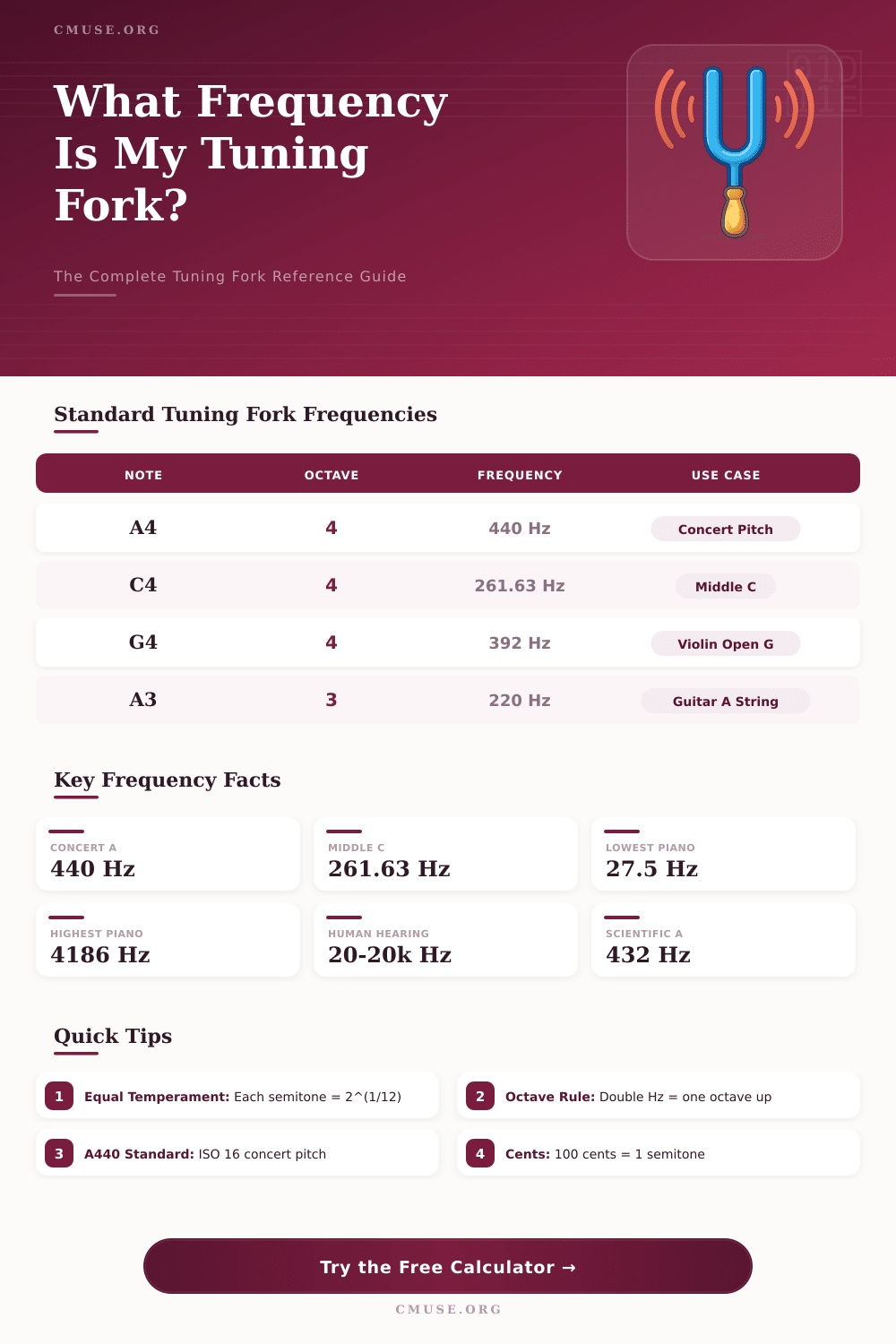
The usual frequency is 440 Hz, what matches the note above middle C in music. Many tuning forks bear the mark A440 on the side.
How Tuning Forks Make Sound
The natural frequency of a tuning fork relates to the size of its teeth. It is inversely linked to the square of the length of those prongs, so if one shortens them, the frequency grows. Adding weight raises the tone, while adding mass lowers it.
To raise the tuning fork frequency, one removes material by filing. When it too highly sounds, one can glue little weight, to lower it.
Tuning forks are sold in a wide range of frequencies, from 64 Hz to 4096 Hz. The fork of 128 Hz is the most used for therapy with sounds. A set of chakra tuning forks can store nine solfeggio frequencies: 174 Hz, 285 Hz, 396 Hz, 417 Hz, 528 Hz, 639 Hz, 741 Hz, 852 Hz and 963 Hz.
There are also weighted forks, that range between 64 Hz and 128 Hz for treatment of body and calming of the nerve system.
Temperature matters. The tone of a tuning fork shifts a little with the heat, mainly because of the slight softening of the steel when it warms. Typical change is 48 parts per million each degree Fahrenheit.
The frequency drops when the temperature grows. A tuning fork of good scientific quality must show the heat, at which it gives its stated tuning fork frequency.
The shape of a tuning fork matters too. During striking, the two teeth move opposite one too the other. That removes the shaking at the base, where they join.
Because of that, holding the fork by the handle does not stop the sound. But grabbing a tooth quickly halts the shaking and the noise. Tuning forks sound much like strings of a violin (they vibrate), forcing the air to move at a set frequency.
Material also changes the tuning fork frequency. Steel is three times rigid and three times dense than copper, so a copper tuning fork of equal size would have around 0.707 times the natural tuning fork frequency of steel. Whole orchestras tune themselves to the sound of one note from a tuning fork.
Historically, the tuning standards varied a lot. The fork of Handel was at 422.5 Hz, while that of Beethoven reached 455.4 Hz, almost half a tone higher than today’s concertpitch. The range varied greatly from city to city and from orchestra to orchestra.