🎵 Time Signature Calculator
Calculate beats per measure, note durations, BPM relationships & rhythmic structure for any time signature
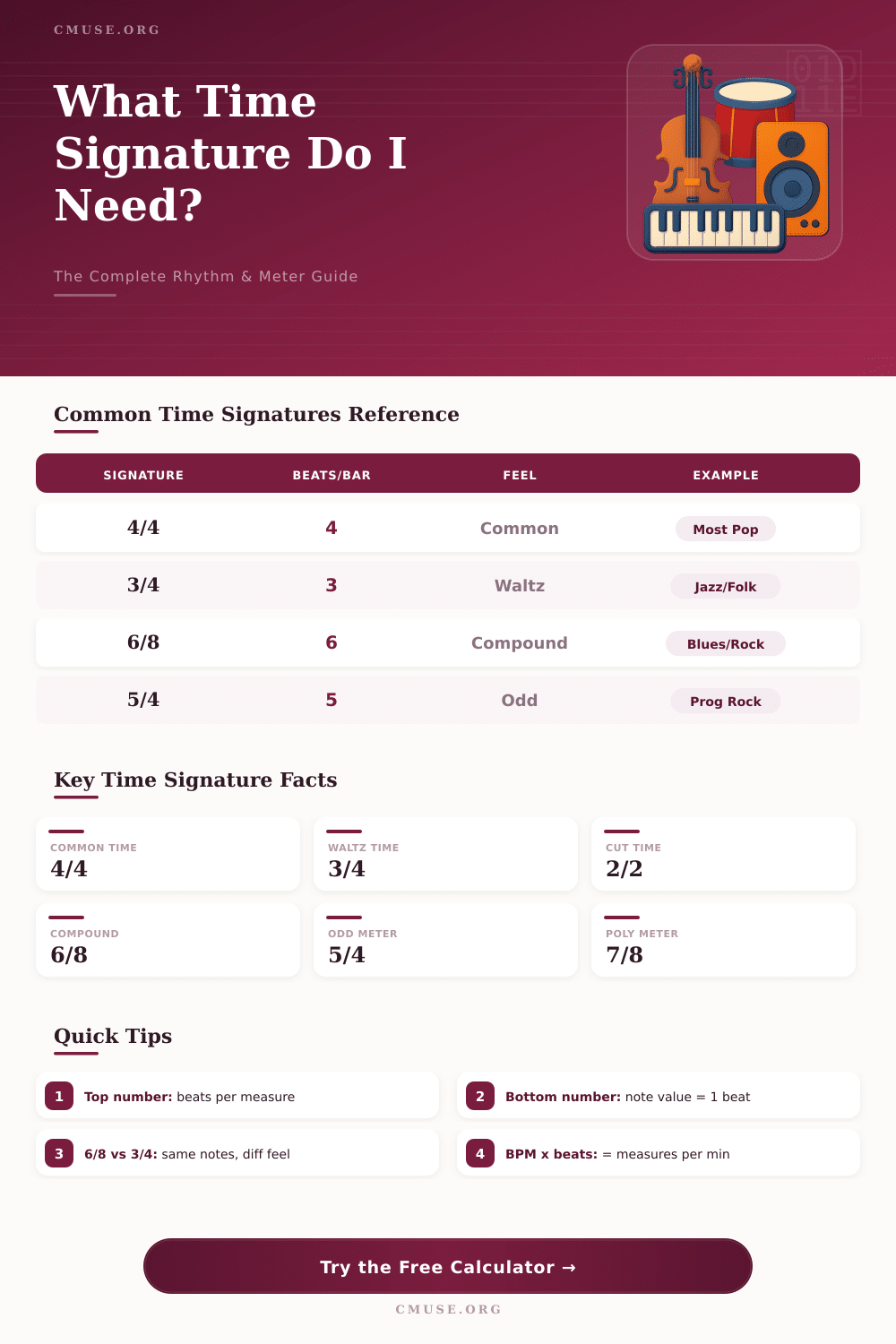
| Time Sig | Beats/Bar | Beat Unit | Type | Feel / Genre Examples |
|---|---|---|---|---|
| 4/4 | 4 | Quarter | Simple Quadruple | Pop, Rock, Hip-Hop, Jazz |
| 3/4 | 3 | Quarter | Simple Triple | Waltz, Jazz Ballad, Folk |
| 2/4 | 2 | Quarter | Simple Duple | March, Polka, Country |
| 6/8 | 6 (2 groups) | Eighth | Compound Duple | Blues, Jig, 12-bar feel |
| 9/8 | 9 (3 groups) | Eighth | Compound Triple | Slow Waltz, Celtic, Folk |
| 12/8 | 12 (4 groups) | Eighth | Compound Quad | Blues, Gospel, Shuffle |
| 2/2 | 2 | Half | Cut Time | March, Classical, Swing |
| 5/4 | 5 | Quarter | Irregular | Prog Rock, Film Score |
| 7/8 | 7 | Eighth | Irregular | Balkan, Prog, Metal |
| 11/8 | 11 | Eighth | Irregular | Experimental, Progressive |
| BPM | Quarter Note (ms) | Eighth Note (ms) | Half Note (ms) | Whole Note (ms) |
|---|---|---|---|---|
| 60 BPM | 1000 ms | 500 ms | 2000 ms | 4000 ms |
| 80 BPM | 750 ms | 375 ms | 1500 ms | 3000 ms |
| 100 BPM | 600 ms | 300 ms | 1200 ms | 2400 ms |
| 120 BPM | 500 ms | 250 ms | 1000 ms | 2000 ms |
| 140 BPM | 429 ms | 214 ms | 857 ms | 1714 ms |
| 160 BPM | 375 ms | 188 ms | 750 ms | 1500 ms |
| 180 BPM | 333 ms | 167 ms | 667 ms | 1333 ms |
| 200 BPM | 300 ms | 150 ms | 600 ms | 1200 ms |
| Time Sig | 60 BPM (sec) | 90 BPM (sec) | 120 BPM (sec) | 160 BPM (sec) |
|---|---|---|---|---|
| 4/4 | 4.00 s | 2.67 s | 2.00 s | 1.50 s |
| 3/4 | 3.00 s | 2.00 s | 1.50 s | 1.13 s |
| 6/8 | 6.00 s | 4.00 s | 3.00 s | 2.25 s |
| 5/4 | 5.00 s | 3.33 s | 2.50 s | 1.88 s |
| 7/8 | 7.00 s | 4.67 s | 3.50 s | 2.63 s |
| 2/2 | 2.00 s | 1.33 s | 1.00 s | 0.75 s |
| 12/8 | 12.00 s | 8.00 s | 6.00 s | 4.50 s |
| 9/8 | 9.00 s | 6.00 s | 4.50 s | 3.38 s |
In simple time (2/4, 3/4, 4/4), the beat divides into 2 equal parts. In compound time (6/8, 9/8, 12/8), the beat divides into 3 equal parts. The top number in compound signatures counts eighth notes, not actual felt beats—divide by 3 for the true number of pulses you feel.
Use this formula: Duration (ms) = (60,000 / BPM) x note relative value. A quarter note at 120 BPM = (60,000/120) x 1 = 500 ms. An eighth note = 250 ms. A whole note = 2000 ms. This is essential for syncing effects, delays, and DAW grid settings to your tempo.
The time signature is made up of two numbers, one above the other, that appears just after the key signature in musical piece. It shows how one must count the music. Those numbers give two pieces of info: how many beats fill every measure and which note gets one beat.
In music, measures form the main structures, that stay equal length in various parts except case of changes in the time signature.
What Is a Time Signature?
The upper number shows how many beats happen in one measure. The bottom number shows which note matches to one beat. For instance, 4 below means that a quarter note has one beat, while 2 shows half note.
The bottom number relates only to notation. If one changes it and rewrites the music with the new note value, it will sound the same.
time signatures stand at the start of musical piece, after the clef and key signature. They help musicians understand how to count and feel the piece before starting to play. Like this one receives guidelines to share and grab the rhythmic pulse of the melody, so that the written sheet music sounds as planned.
In almost every music, the most common time signature is 4/4. One hears it in classic songs as “One Love” by Bob Marley or “Seven Nation Army” by the White Stripes, where the rhythmic pattern repeats with four beats. Between all, the main time signatures are 4/4, 3/4, 2/4, 6/8, 9/8 and 12/8.
Common pop usually uses 4/4.
There are three kinds of time signatures: simple, compound and mixed. Simple time splits beats in two. When two smaller notes come for one measure tap, that is simple time.
If three smaller notes per tap, it becomes compound time. When the upper number goes past four, it usually splits by means of three. For instanse, 6/8 holds two beats per measure, every group with three smaller notes.
9/8 has three beats, and 12/8 four beats.
Words as duple, triple and quadruple metres relate to the upper number, that shows how many beats in measure. Time signatures can be also unclear, so do recall that.
Apparently, the melody appears first. Later one counts the time signature according to the natural flow of the melody. A composer does not choose time before and then attach the melody to it.
Rhythm is born from equal pauses between beats, and the time signature helps count that rhythm too no exactly, when to play a note. The clear patterns, that the time signature shows, define how one hears and feels the metre of the piece.
Unusual signatures as 7/8 create dynamic, pushing energy, as if each measure leans to the next. In Bulgaria, women dance in 7/8 and 11/8, sothere does not exist reason to fear them.