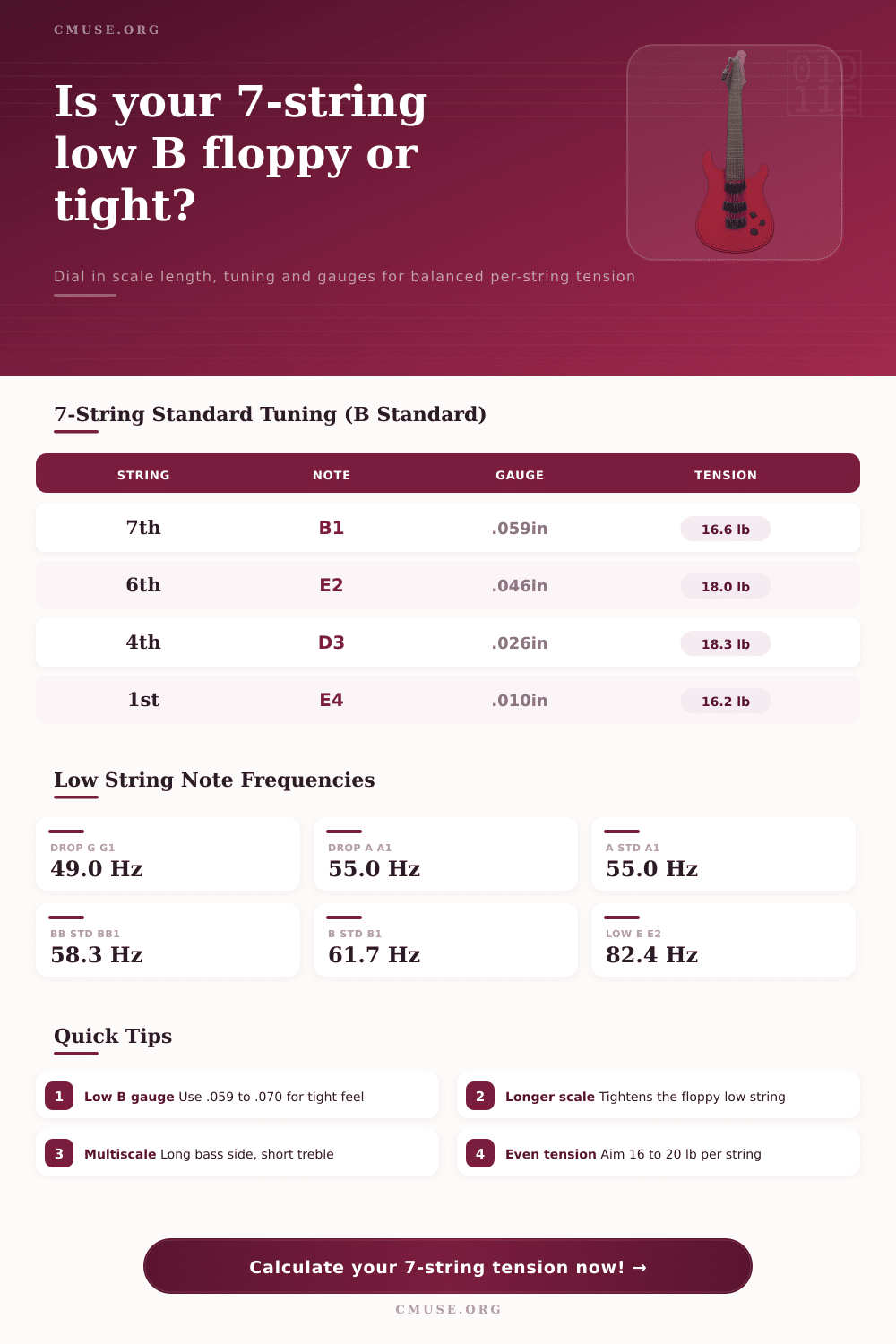
7 String Tuning Calculator
Find your low B note, frequency and per-string tension, then dial in the right low-string gauge
Per-String Breakdown
| String | Note | Freq (Hz) | Gauge (in) | Tension (lbs) |
|---|---|---|---|---|
| 7th (low) | B1 | 61.74 | .059 | 16.6 |
| 6th | E2 | 82.41 | .046 | 18.0 |
| 5th | A2 | 110.00 | .036 | 19.6 |
| 4th | D3 | 146.83 | .026 | 18.3 |
| 3rd | G3 | 196.00 | .017 | 16.6 |
| 2nd | B3 | 246.94 | .013 | 15.4 |
| 1st | E4 | 329.63 | .010 | 16.2 |
| Tuning | 7th (Low) | Strings 6 to 1 | Typical Scale |
|---|---|---|---|
| B Standard | B1 | E2 A2 D3 G3 B3 E4 | 25.5 to 26.5in |
| Bb Standard | Bb1 | Eb2 Ab2 Db3 Gb3 Bb3 Eb4 | 25.5 to 26.5in |
| A Standard | A1 | E2 A2 D3 G3 B3 E4 | 26.5 to 27in |
| A# Standard | A#1 | F2 A#2 D#3 G#3 C4 F4 | 25.5 to 26.5in |
| Drop A | A1 | E2 A2 D3 G3 B3 E4 | 25.5 to 26.5in |
| Drop G | G1 | D2 G2 C3 F3 A3 D4 | 27in plus |
| Scale Length | Light Feel | Balanced Feel | Tight Feel |
|---|---|---|---|
| 25.5in | .056 | .060 | .064 |
| 26.5in | .054 | .058 | .062 |
| 27.0in | .052 | .056 | .060 |
| 28.0in | .050 | .054 | .058 |
| 25.5 to 27 multiscale | .052 | .056 | .060 |
| Note | MIDI | Freq (Hz) | Common Use |
|---|---|---|---|
| F1 | 29 | 43.65 | Extended 8-string low |
| G1 | 31 | 49.00 | Drop G 7-string |
| Ab1 | 32 | 51.91 | Drop Ab 7-string |
| A1 | 33 | 55.00 | Drop A / A Standard |
| A#1 / Bb1 | 34 | 58.27 | A# / Bb Standard |
| B1 | 35 | 61.74 | B Standard 7-string |
| C2 | 36 | 65.41 | C Standard 7-string |
So there you are for the very first time stretching your hand across the neck of a seven-string guitar. Without thinking too much about it you reach down to the bottom string (the low B) and bash out a note. Except this isn’t what happens: you don’t hear that clean fundamental sound; instead, all you get is a muddy thud. As you play the note, you can feel it vibrating along with each of the other strings on the instrument. When you pick it hard, the note seems somehow loose and unstable in it pitch.
This is called the floppy string problem and it’s by far the most common complaint among people who has upgraded their guitars from a six-string. Very rarely does it come down to your playing technique. Usually it comes down to how you tune, the scale length of your guitar, and thickness of metal wound around the lowest post.
How to Fix Floppy Seven-String Guitars
After you plug in your set-up information, the calculator do all the work (no more guesswork, converting and calculating coefficients). It provides you with the solution to something called “tension balance.” Tension is the invisible force that holds a guitar together musically. Imagine if your low B string pulls on the neck with ten pounds of tension while your high E string pulls with sixteen; this inconsistency in tension across the fingerboard will affect how it feel to play. The low end may feel like rubber and your high notes choke out.
Most players prefers their strings to fall somewhere between sixteen and twenty pounds per string. That’s a pretty small window of variation but gives you the ability to articulate and bend freely without compromising note stability. So when you put your scale length and preferred tuning in the tool, you can see if you’re currently using a set of strings that are within the comfort zone or not.
If the standard gauge doesn’t have enough stretch on a particular guitar then the only thing that changes is the scale length. For example, six-strings is comfortable on a twenty-five-and-a-half inch scale because the tension ratios matches well with standard light gauges. Now drop the pitch and add a seventh string, and those same physics won’t be working in our favor anymore. If we maintain the same gauge, the tension increases as the vibrating length of the string grow.
Many moddern seven-string guitars has a twenty-seven-inch scale or use some sort of multiscale design by fanning out the frets. This allows the low strings to gain more length for better tension while keeping the high strings at a manageable stretch for your hand. It’s a geometric compromise between ergonomics and tonal clarity.
Beyond gauges, players tend to overlook material choice when considering tension. Nickel wound strings sound great but are also slightly softer and smoother feeling different than stainless steel. If you’re finding your low B is too floppy on a nickel set, try some stainless steel. It could tighten up the response without forcing you to jump to an insanely thick string that will hurt your fingers.
To make things even clearer, here’s the tension table from the page showing where different materials fit in with scale length to create target tensions. Notice how heavy gauge on a short scale acts like light gauge on a long scale. It will help you visualize those relationships. A lot of people think it’s just about following a chart, but it’s more about matching the geometry of the instrument to how you play. You’re choosing a low string that matches the instrument’s shape to your playing style.
So if you’re an aggressive player, you want the strings to have more tension so that when you’re making a downstroke, it doesn’t buzz off the frets. On the other hand, if you like to tap and play smoothly then you don’t want the string to have so much tension that your finger fights each note. That’s where this tool comes into play. Once you know how much tension you’re after, it recommends a gauge for you to try. It tells you if your string is fifty-nine thousandths of an inch thick, or if you should of go up to the next step and get something like seventy thousandths to give yourself a nice tight defined low end.
Adding one string to your six-string doesn’t make it just another six-string with a dangling part. It does require rethinking how tension is spread across the whole neck. When you treat gauge, scale, and material as things that work together rather than separate choices, the floppy B goes away, and you end up playing the instrument instead of wrestling with it. It has solid low-end, singable high-end, and works as a cohesive system.