3rd Order Crossover Calculator
Estimate Butterworth speaker crossover values for 3rd-order high-pass and low-pass networks.
🔌 Calculator Inputs
📊 Reference Table
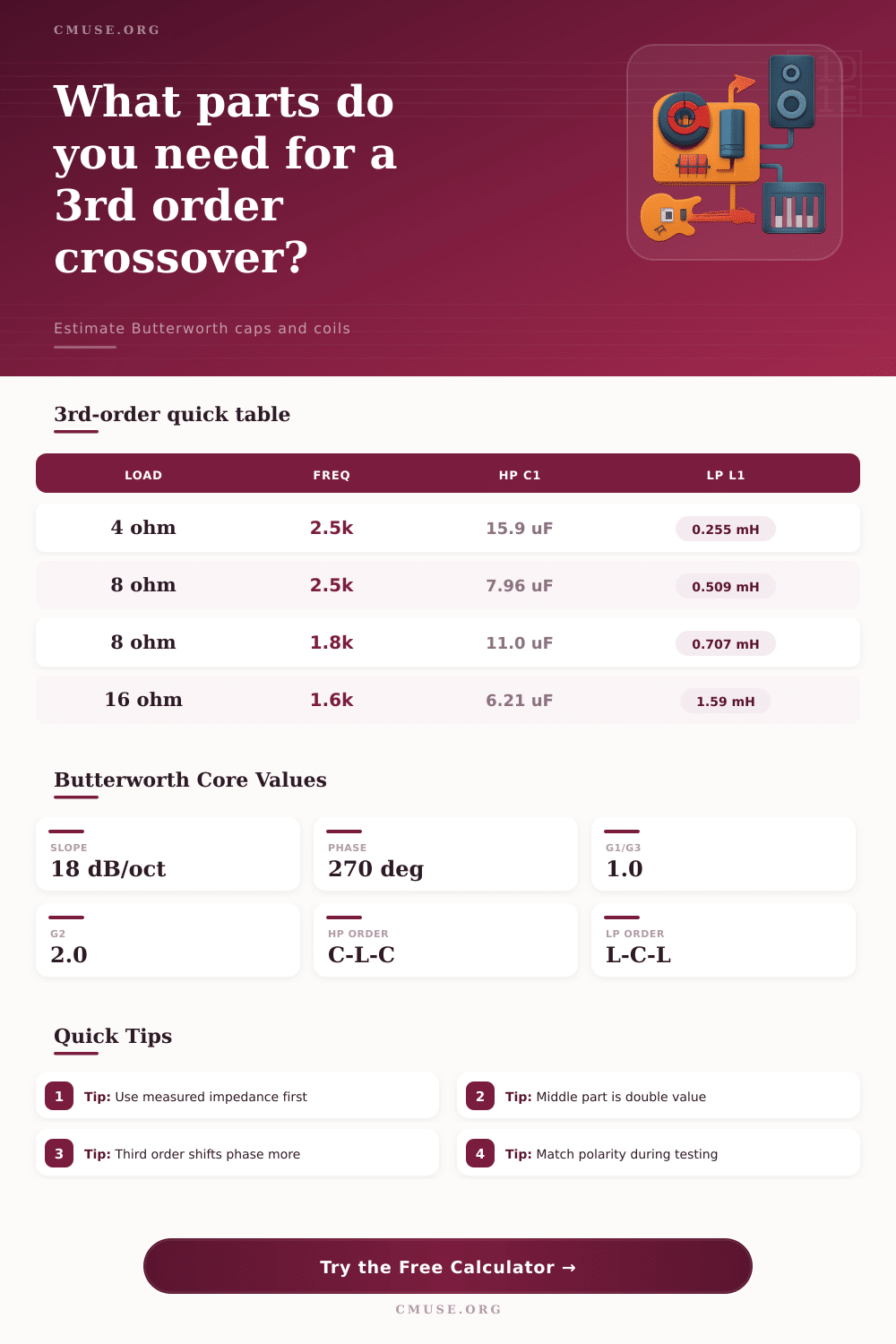
| Load | Freq | HP C1 | LP L1 |
|---|---|---|---|
| 4 ohm | 2.5 kHz | 15.9 uF | 0.255 mH |
| 8 ohm | 2.5 kHz | 7.96 uF | 0.509 mH |
| 8 ohm | 1.8 kHz | 11.0 uF | 0.707 mH |
| 16 ohm | 1.6 kHz | 6.21 uF | 1.59 mH |
🔧 Butterworth Specs
Crossover order is a term used in various fields, from speaker designs to genetic algorithms. In speaker design, crossover order shows how sharply the filter curves of frequencies roll off. First order crossover uses one capacitor or inductor for the driver.
Second order has two parts for every driver, third order three, and so on. Really, you can recognize it easily by counting the parts
Crossover Order in Speakers and Genetic Algorithms
First order crossover rolls off -6 dB each octave. It adds only minimal time shift to the signal. Fourth order crossover at -24 dB each octave drops the power to 1/256 each octave.
It became the standard choice for professional systems, because it gives maximum control over the speakers, but requires precies configuration.
Phase shift is another important topic. First order crossover does not cause phase change. Second order creates a 180 degree phase shift, third order 270 degrees, and fourth order ends with a full 360 degree change.
A well designed crossover preserves phase in the crossover region, regardless of the order. If you use a second order Linkwitz-Riley filter between two drivers, one of them must be reversed for it to work correctly. At fourth order Linkwitz-Riley filter, polarity reverse is not needed.
In sharper crossovers, the more the phase gets mangled and the design gets complex quickly. First order indeed beats higher orders in mixing scenarios. The final order combines electrical and acoustic response, so you can reach second order response using first order parts, depending on the acoustic response of the driver itself.
It is no problem to mix second order and third order filters. The crossover simply must adapt to the particular drivers. DSP offers the most powerful active crossover available on the market now.
Some producers add extra filter sections in their crossovers, commonly adding a second woofer, that plays the same bass, but rolls off much earlier than the main woofers.
In genetic algorithms, order crossover comes from Davis. It copies information about the relative order of the second parent to the child. Randomly you choose two spots in the parents, and the genes between them of one parent move directly to the child.
For the other values, you fill gaps with the values from the first parent according to its order. Hybrid genetic search uses order crossover operator, that takes two solutions as input and generates a new solution for the searchtospace.