2nd Order Crossover Calculator
Estimate passive speaker crossover parts for 2nd order high-pass and low-pass filters.
🎧 Crossover Inputs
📊 Reference Table
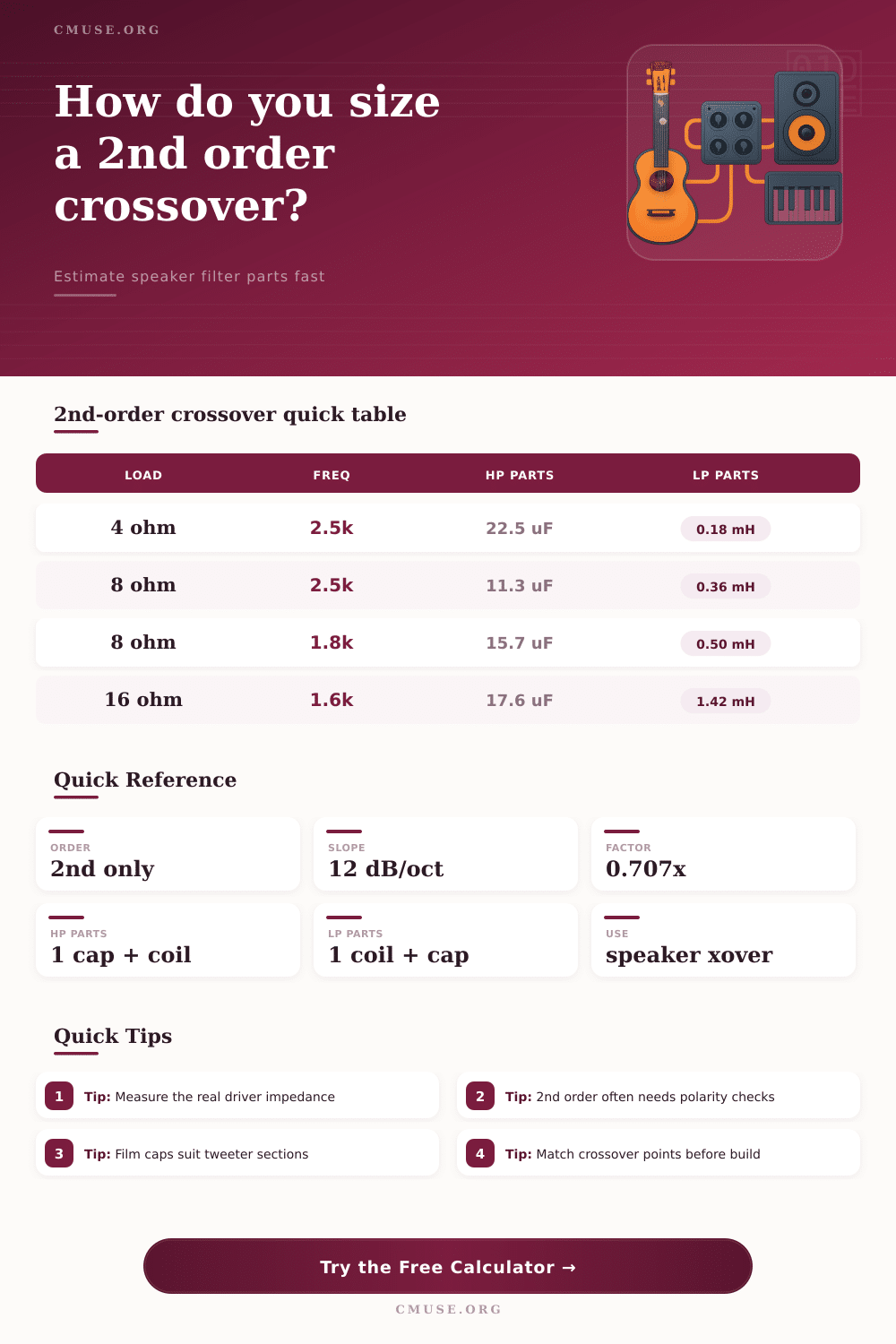
| Load | Freq | HP Parts | LP Parts |
|---|---|---|---|
| 4 ohm | 2.5 kHz | 22.5 uF | 0.18 mH |
| 8 ohm | 2.5 kHz | 11.3 uF | 0.36 mH |
| 8 ohm | 1.8 kHz | 15.7 uF | 0.50 mH |
| 16 ohm | 1.6 kHz | 17.6 uF | 1.42 mH |
🔧 Filter Specs
A crossover order can mean different things depending on the context. In audio and speakers, it shows how sharply the filters block frequencies. Genetics and algorithms talk about how information gets passed between parent solutions.
Both uses are interesting in their own way.
Crossover Order in Audio and Genetic Algorithms
Audio crossover order points to the number of parts for every driver. First order uses one capacitor or inductor for it. Second order requires two, third three, and so on.
You easily spot it simply by counting the parts.
First order adds only a bit of time lag to the signal, so it rolls off at -6 dB each octave. Fourth order rolls off at -24 dB each octave. It became the standard for professionals, because it well controls speakers and requires precise alignment.
Different crossover orders cause different phase shifts. First order does not alter the phase. Second gives 180 degrees, third 270, and fourth 360 degrees.
A well designed crossover keeps the phase steady in the crossover region, regardless of the order.
With a fourth order Linkwitz-Riley filter between two drivers, you do not reverse polarity. But for second order LR, you must reverse one of them, so that it works well. The final order comes from electrical and acoustic response, so you can reach second order by means of first order parts.
In a steeper crossover, the phase more messes up, and the build gets complex quickly. First order usually beats higher in a blender scenario. Higher order crossovers have problems, that you avoid by means of a speaker that extends its range by means of a lower order.
It does not matter to mix second and third order filters, just adapt the parts to the drivers.
In genetic algorithms, the order crossover comes from Davis in its basic form. It copies the relative order from the second parent too the child. A hybrid genetic search uses this operator: it takes two solutions as input and creates a new one for the search.
The process starts by choosing parents, copying a random section from the first, and filling the gaps with values from the second in its own order.
A DSP offers the highest order active crossover available on the market right now. Some companies add extra filters in their systems, usually for a second bass speaker, thatreproduces the same bass, but rolls off much more early than the main one.