2D Diffuser Calculator
Calculate a skyline diffuser grid from panel size, cell width, prime order, design frequency, and residue depth steps.
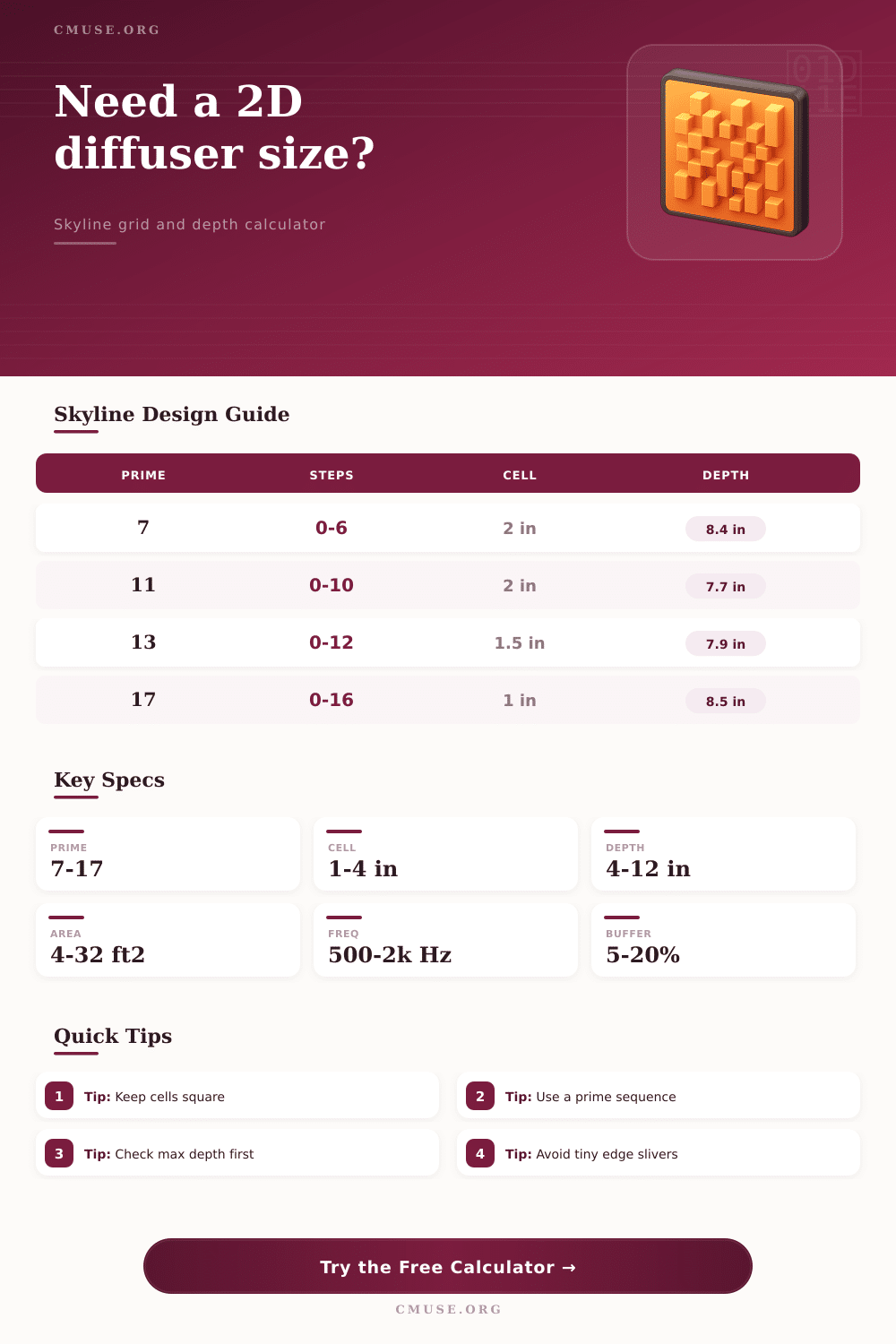
| Prime Order | Depth Values | Best Panel Use | Design Note |
|---|---|---|---|
| 5 | 0 through 4 | Door, booth, cloud | Fast repeat, shallow pattern |
| 7 | 0 through 6 | Small studio walls | Compact 2D diffusion |
| 11 | 0 through 10 | Mix room rear wall | Good balance of depth and scatter |
| 13 | 0 through 12 | Live room panels | More varied well depths |
| 17 | 0 through 16 | Large wall arrays | Needs tighter cells or a larger panel |
| Cell Width | Metric Width | Approx Upper Limit | Common Use |
|---|---|---|---|
| 1 in | 2.5 cm | 6.8 kHz | High resolution skyline |
| 1.5 in | 3.8 cm | 4.5 kHz | Control room detail |
| 2 in | 5.1 cm | 3.4 kHz | General studio panel |
| 3 in | 7.6 cm | 2.3 kHz | Large blocks, deeper scatter |
| 4 in | 10.2 cm | 1.7 kHz | Large room visual feature |
| Room Scenario | Panel Size | Typical Cell | Prime Choice |
|---|---|---|---|
| Recording booth | 18 x 18 in | 1.5 in | 7 or 11 |
| Mix position pair | 24 x 24 in | 2 in | 7 or 11 |
| Rear wall panel | 36 x 24 in | 2 in | 11 or 13 |
| Live room array | 48 x 36 in | 3 in | 13 or 17 |
| Stage scatter wall | 72 x 48 in | 4 in | 17 or 19 |
| Material | Density | Panel Behavior | Best Fit |
|---|---|---|---|
| Rigid foam core | 6 lb/ft³ | Light, easy to mount | Clouds and light panels |
| Light pine | 25 lb/ft³ | Moderate weight | Small room panels |
| Poplar | 28 lb/ft³ | Stable block stock | Balanced studio builds |
| Baltic birch | 34 lb/ft³ | Dense, clean edges | High detail skyline grids |
| MDF blocks | 45 lb/ft³ | Heavy and uniform | Fixed wall installations |
Two-dimensional diffusers are tool that help to scatter the sound waves in two different dimension. Two-dimensional diffusers are often used in a small studio in which the reflections from the walls can impact the vocal track being recorded. If the vocal tracks were to include two-dimensional diffusers, the mix can turn from a clean mix to a crowded mix.
Before any block are to be cut for the creation of a two-dimensional diffuser, a calculator can be used to ensure that the sizing of the two-dimensional diffuser is correct. The two-dimensional diffuser often utilizes a prime number of well for the creation of its depths. The depths of each well are calculate based off the design frequency, the speed of sound, and the prime order of the two-dimensional diffuser.
How to design a two-dimensional diffuser
A calculator will calculate the step depth for the two-dimensional diffuser and calculate the maximum depth of each well that will be created within the two-dimensional diffuser panel. This maximum depth of each well is another important number for the creation of the two-dimensional diffuser. This maximum depth will determine the lowest frequency that the two-dimensional diffuser will reflect.
If this measurement is too great for the available space, the designer can raise the design frequency or the designer can reduce the prime order. Each of these changes will decrease the depth of the deepest well of the two-dimensional diffuser. Another factor to consider within the creation of the two-dimensional diffuser is the width of each cell.
If the cells are made narrower, the two-dimensional diffuser will reflect higher frequencies. This is due to the fact that narrower cells will allow the two-dimensional diffuser to impact higher frequency. However, if the cells are narrowed, more blocks will have to be cut.
If the cells are made wider, there will be less labor in the creation of the two-dimensional diffuser. Wider cells will reflect better in large walls, but they will begin to act as flat surfaces for frequencies that are reflected past a certain point. Reference table can help to determine the size of each cell and the upper limit of the frequencies that will be reflected.
The material that is used for the creation of the two-dimensional diffuser will impact the weight of the two-dimensional diffuser and the accuracy of the two-dimensional diffuser. Using wood that are more dense will allow the two-dimensional diffuser to have clean edges. These clean edges are important for maintaining the accuracy of the calculated depths.
Using lighter materials for the two-dimensional diffuser will reduce the load on the wall upon installation. However, the lighter the material for the two-dimensional diffuser, the more likely it will flex if it is a large panel. The calculator can determine both the density and the approximate weight of the two-dimensional diffuser when completed.
The grid count for the two-dimensional diffuser will be determined by the dimension of the panels that are to be used for the installation. Each dimension will be divided by the size of the cells. Any remaining measurement will be discarded.
Even if the leftover strip is relatively wide, it is better to use a panel that is slightly smaller and fits entirely within the grid, rather than forcing a strip that is barely wide enough to include a single row of cell. Due to the fact that most room are not created with theoretical conditions, the calculated frequency ranges may not be met. Many builder will start with a relatively low prime order for their two-dimensional diffusers panels.
If the problems in the room are not solved with the first array of two-dimensional diffusers, a second array can be installed. The builder can swap the primes for the two-dimensional diffuser so that they can view the impact that it will have upon the size of the deepest well of the two-dimensional diffuser. A two-dimensional diffuser does not require a great amount of total depth.
A well of only a few inch in depth will reflect the necessary midrange frequencies. The temptation may exist to make the depth of each well more greater in order to reflect lower frequencies. However, deep well can cause problems with mounting the two-dimensional diffuser into the wall.
The input provided into the calculator for the two-dimensional diffuser can limit the depth of each well. This limitation will allow the calculator to flag any depth that may be too deep for the individual to build the two-dimensional diffuser. The placement of two-dimensional diffusers within a room can impact the range of frequencies that are reflected from the panels.
Two-dimensional diffusers can be placed on the rear wall of a mixing studio that is utilized for the positioning of the individuals that are creating the vocal tracks. Smaller panels can be placed on the side walls of the mixing studio. Two-dimensional diffusers that are much lighter in weight can be placed into the clouds above a vocal booth or an individual’s desk.
The calculator will not make placement decisions. However, the calculator can provide the area, the volume, and the weight of each two-dimensional diffuser for the individual to compare different placement option within the mixing studio. The design frequency for a two-dimensional diffuser is not the only frequency that will be reflected by the two-dimensional diffuser.
There will be some effect upon the frequencies that are both above and below the design frequency. However, the efficiency of the two-dimensional diffuser may decrease if it is only designed to reflect certain frequency ranges. Often times, the calculation of the dimension of the two-dimensional diffuser can be started at a frequency that is slightly higher than the lowest frequency that is having problems within the mixing room.
By beginning the calculation at a higher frequency, the two-dimensional diffuser will often integrate better with the other sound absorbing panels within the mixing studio. Furthermore, by listening to the studio with the two-dimensional diffuser installed, the person can verify the results of the calculations that were made with the calculator. By building a single panel and integrating it into the mixing studio for a few weeks, the individual can determine if the two-dimensional diffuser is having the desired effect upon the vocal tracks.
Often times, if the problem frequencies are smoothed out and the vocal tracks have a more stable image within each stereo speaker, the calculations were successful. In the case that the reflections are not smoothed out within the mixing room, the tool can be utilized again to adjust any factor of the two-dimensional diffuser panel, such as the width of the cells, the order of the prime number for the panel, or the size of the panel itself. Each mixing studio and each individual listener has different ear, so the process is iterative and may require several adjustments before the proper settings are found.