🔊 1st Order Crossover Calculator
Calculate exact capacitor & inductor values for your passive speaker crossover network
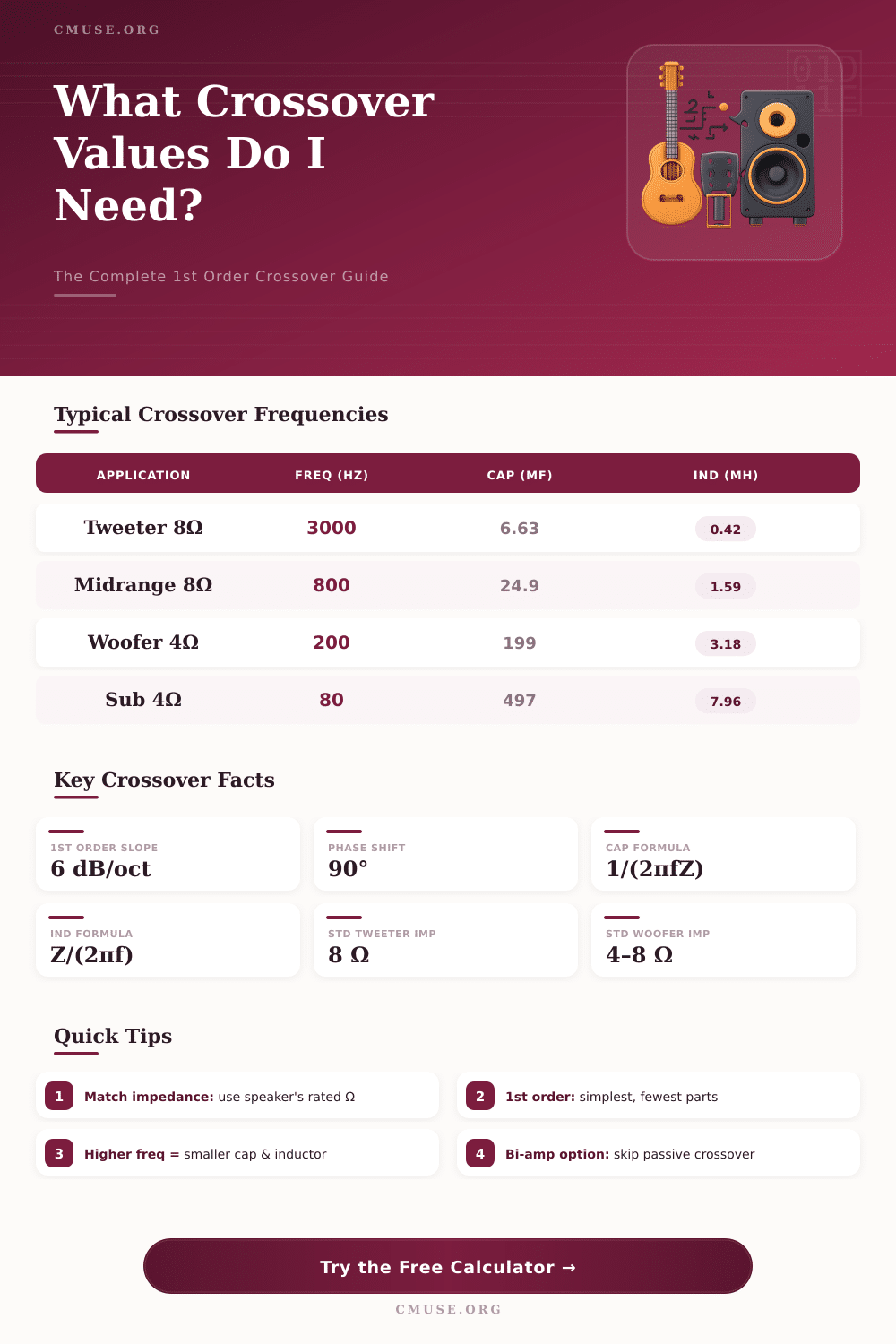
Capacitor (µF) and Inductor (mH) values for common crossover frequencies at standard impedances.
| Freq (Hz) | 4 Ω Cap (µF) | 8 Ω Cap (µF) | 4 Ω Ind (mH) | 8 Ω Ind (mH) |
|---|---|---|---|---|
| 80 | 497.4 | 248.7 | 7.96 | 15.92 |
| 200 | 198.9 | 99.5 | 3.18 | 6.37 |
| 500 | 79.6 | 39.8 | 1.27 | 2.55 |
| 800 | 49.7 | 24.9 | 0.80 | 1.59 |
| 1200 | 33.2 | 16.6 | 0.53 | 1.06 |
| 2000 | 19.9 | 9.95 | 0.32 | 0.64 |
| 2500 | 15.9 | 7.96 | 0.25 | 0.51 |
| 3000 | 13.3 | 6.63 | 0.21 | 0.42 |
| 5000 | 7.96 | 3.98 | 0.13 | 0.25 |
| 10000 | 3.98 | 1.99 | 0.06 | 0.13 |
Standard capacitor values (µF) for high-pass filters — C = 1 / (2π × f × Z)
Standard inductor values (mH) for low-pass filters — L = Z / (2π × f)
| Octaves from Fc | Frequency Ratio | Attenuation (dB) | Signal Level (%) |
|---|---|---|---|
| At Fc (–3 dB) | 1.0x | –3.01 dB | 70.7% |
| 1 octave out | 0.5x / 2x | –7.0 dB | 44.7% |
| 2 octaves out | 0.25x / 4x | –13.0 dB | 22.4% |
| 3 octaves out | 0.125x / 8x | –19.1 dB | 11.1% |
| 4 octaves out | 0.0625x / 16x | –25.1 dB | 5.6% |
| Speaker Type | Typical Fc Range | Filter Type | Notes |
|---|---|---|---|
| Dome Tweeter | 2,000 – 4,000 Hz | High-Pass | Protects from low-freq damage |
| Ribbon Tweeter | 3,000 – 6,000 Hz | High-Pass | Fragile — use higher Fc |
| Midrange Driver | 500 – 1,500 Hz | Band-Pass | Needs both HP + LP |
| Woofer (2-way) | 2,000 – 3,500 Hz | Low-Pass | Standard 2-way crossover |
| Woofer (3-way) | 300 – 800 Hz | Low-Pass | Crosses to midrange |
| Subwoofer | 60 – 120 Hz | Low-Pass | Home theater / bass |
| PA Full Range | 1,200 – 2,500 Hz | Both | Live sound reinforcement |
Crossover order can mean different things depending on the context. In audio and speaker design, it relates to the steepness of the frequency filter. Genetic algorithms use it to mix two parent solutions and make a new one.
Both uses are very common so it helps to explain them
What Crossover Order Means in Speakers and in Genetic Algorithms
Speaker crossover of first order uses only one capacitor or inductor for every driver. Second order needs two parts for each driver, third order three, and so on. You recognize the order simply by counting the parts.
First order is made of one filter with inductor and capacitor. It adds small time shift to the signal, but drops only -6 dB each octave. Fourth order reaches -24 dB each octave and became the standard in professional systems because of good control of the drivers and need of precise alignment.
Most folks do not care about the stepeenness of crossover. The sharper it is, the more the phase shifts and the whole system gets complex. First order crossovers even beat the higher ones in mixing scripts.
DSP offers the most powerful active high-order variant available on the market.
Phase motion changes according to the order. First order does not change the phase. Second order causes 180 degrees of motion, third 270 degrees, and fourth ends with 360 degrees.
With Linkwitz-Riley filter of fourth order between two drivers, you do not need to reverse polarity. At second order LR filter however you must reverse one driver for it to work. Well designed crossover keeps phase in the zone regardless of the order.
The real order mixes electrical and acoustic response. You can reach second order using first order parts. The resulting crossover order depends on the acoustic response of the drivers themselves, which decides what parts must be used.
In genetic algorithms the order crossover comes from Davis in his original version. It copies the relative order of the second parent to the child. You choose two random spots in the parents, copy the genes between them from parent one to child one and from parent two to child two.
Hybrid genetic algorithm applies each order crossover as an operator, that takes two solutions as input and gives a new solution for the explorationof the search.